
Last updated November 3, 2026
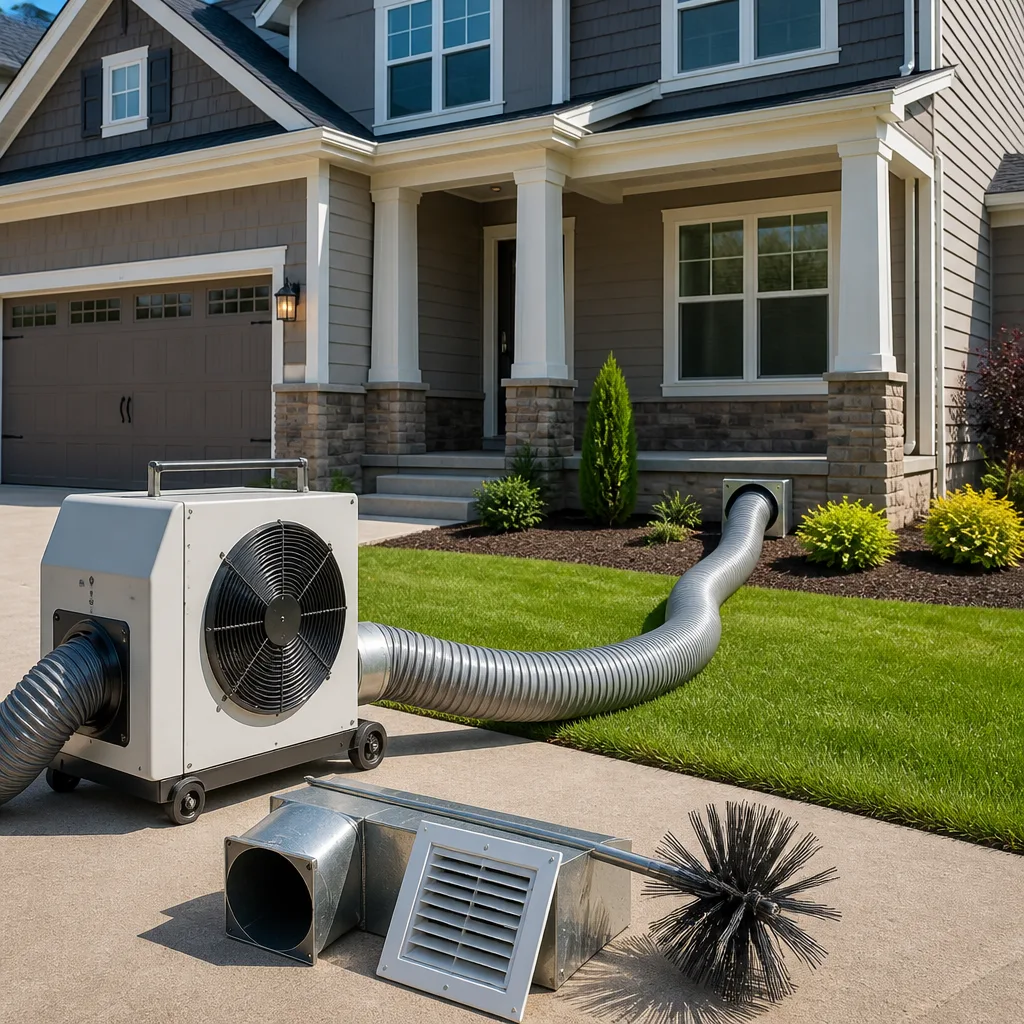 Whole-home duct cleaning
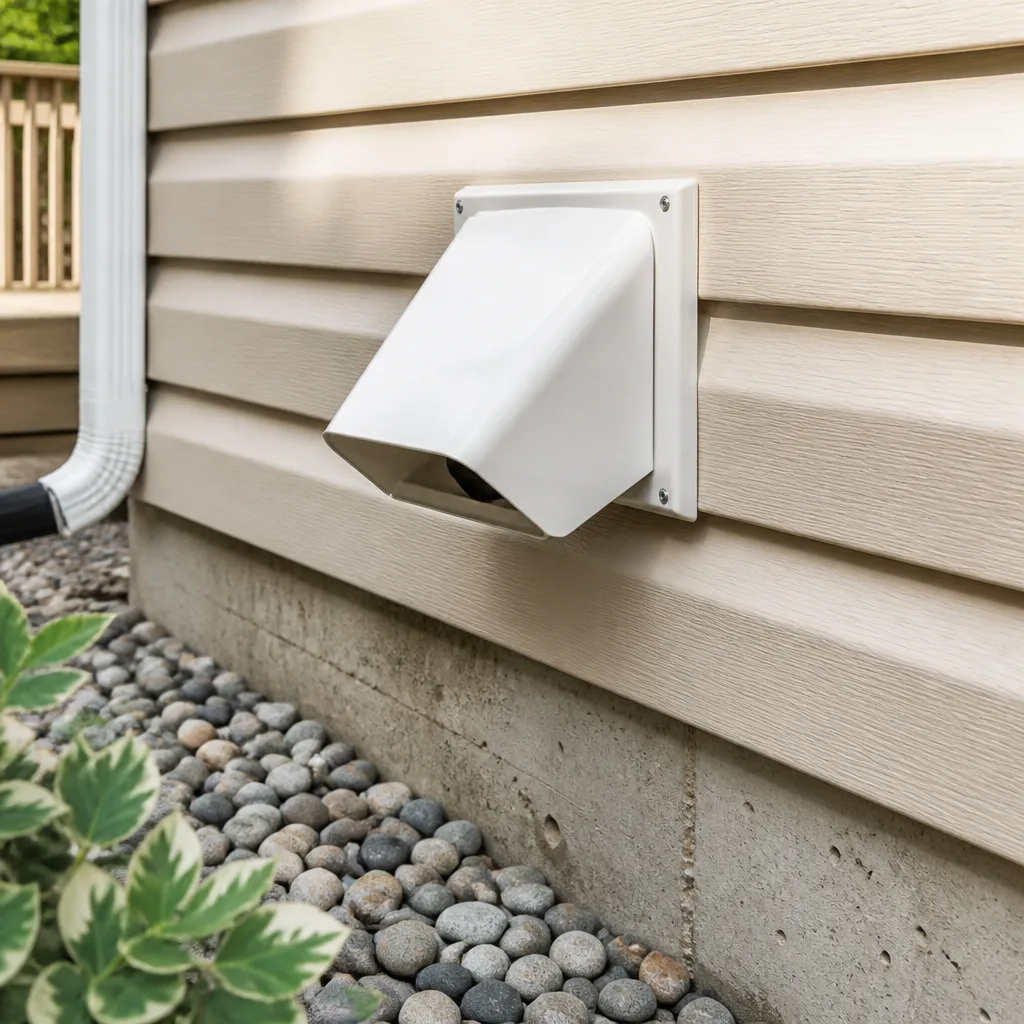 Dryer vent cleaning
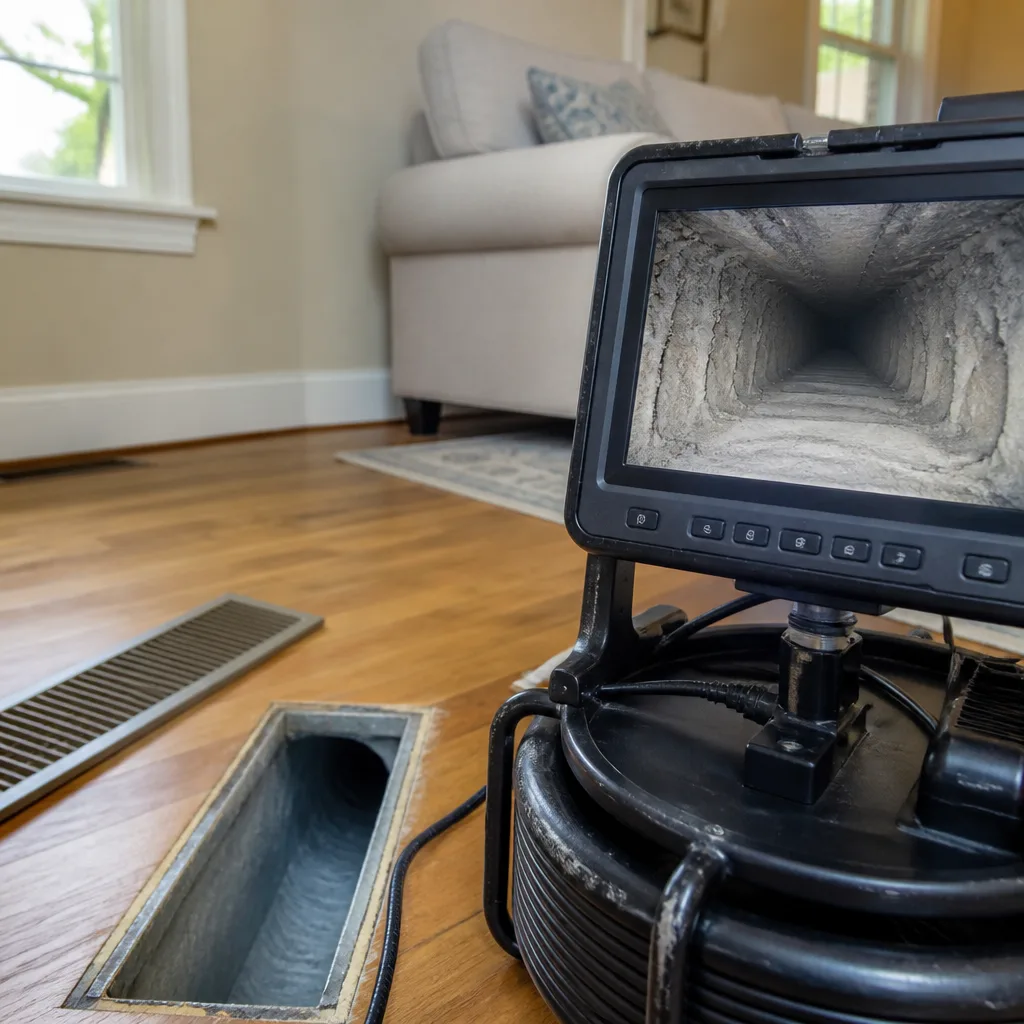 Camera inspection
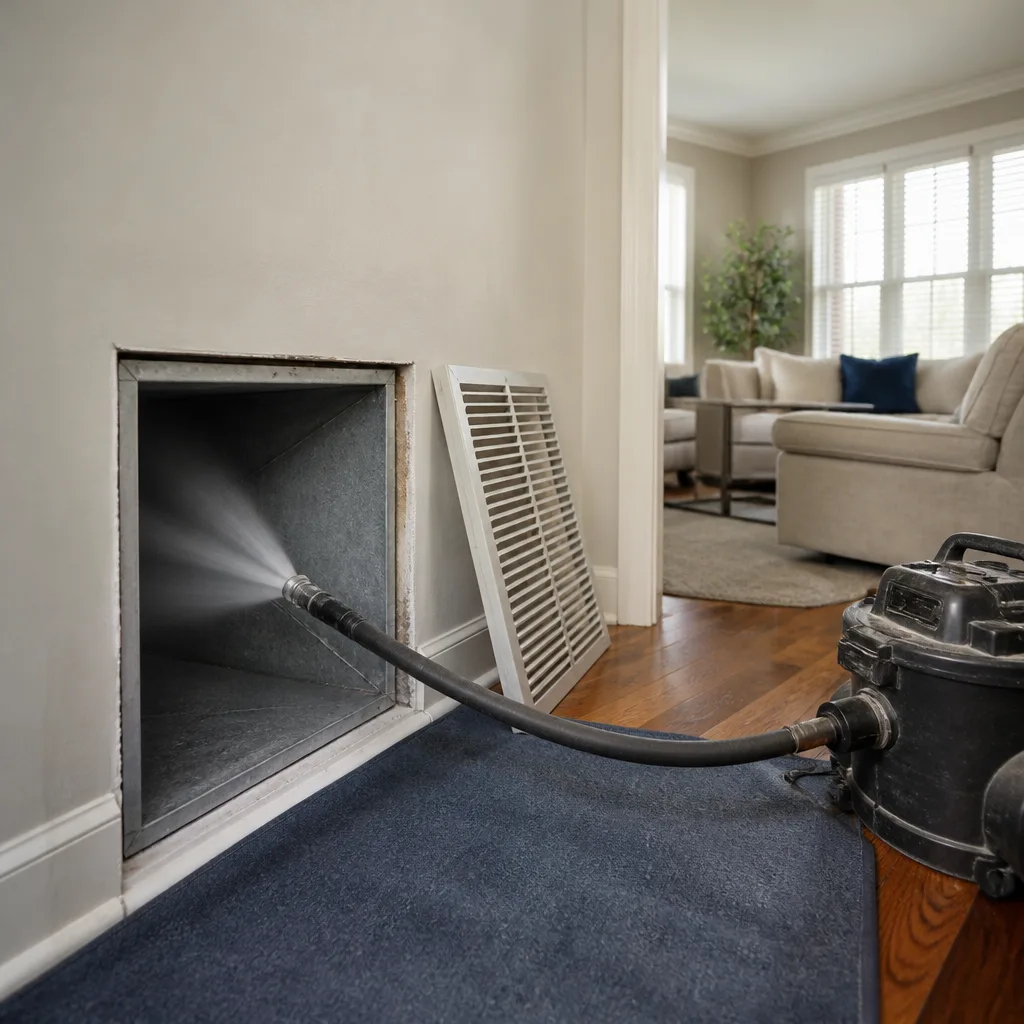 Sanitizing & deodorizing
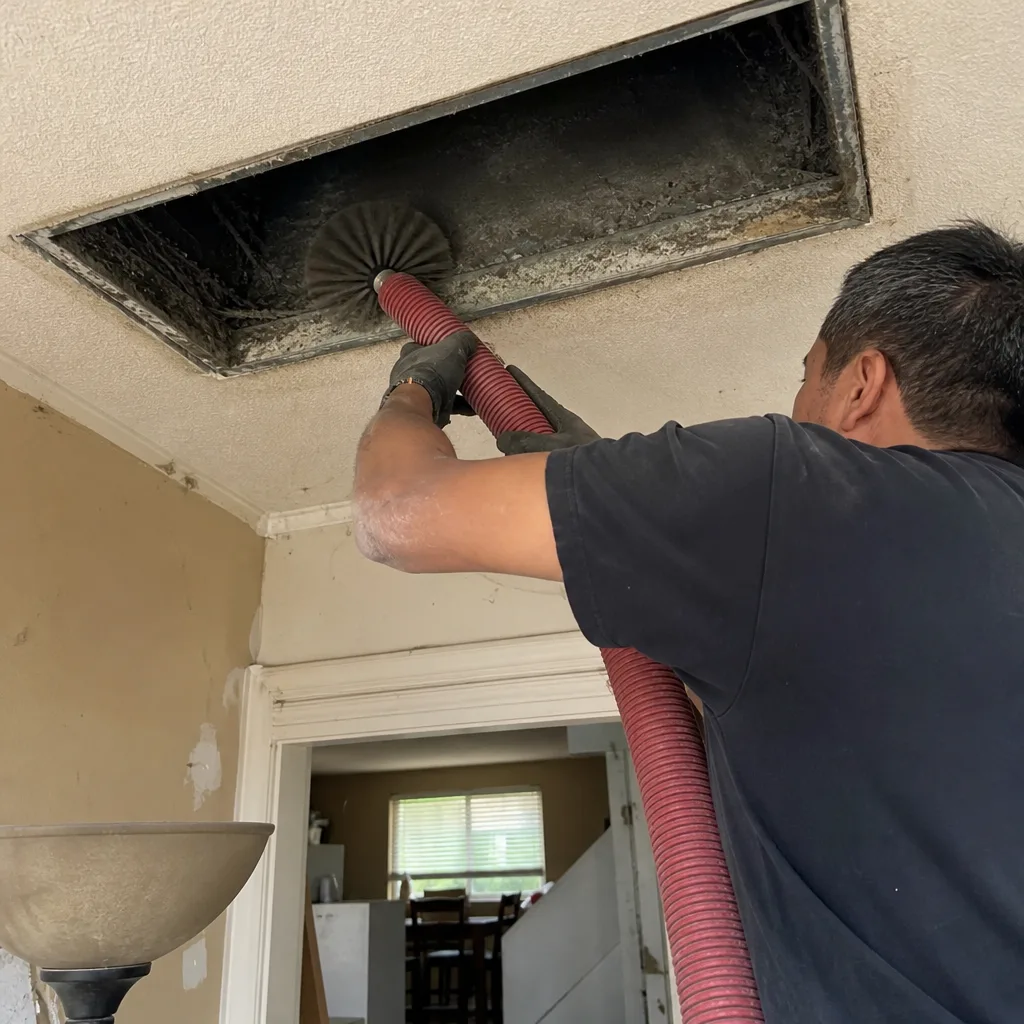
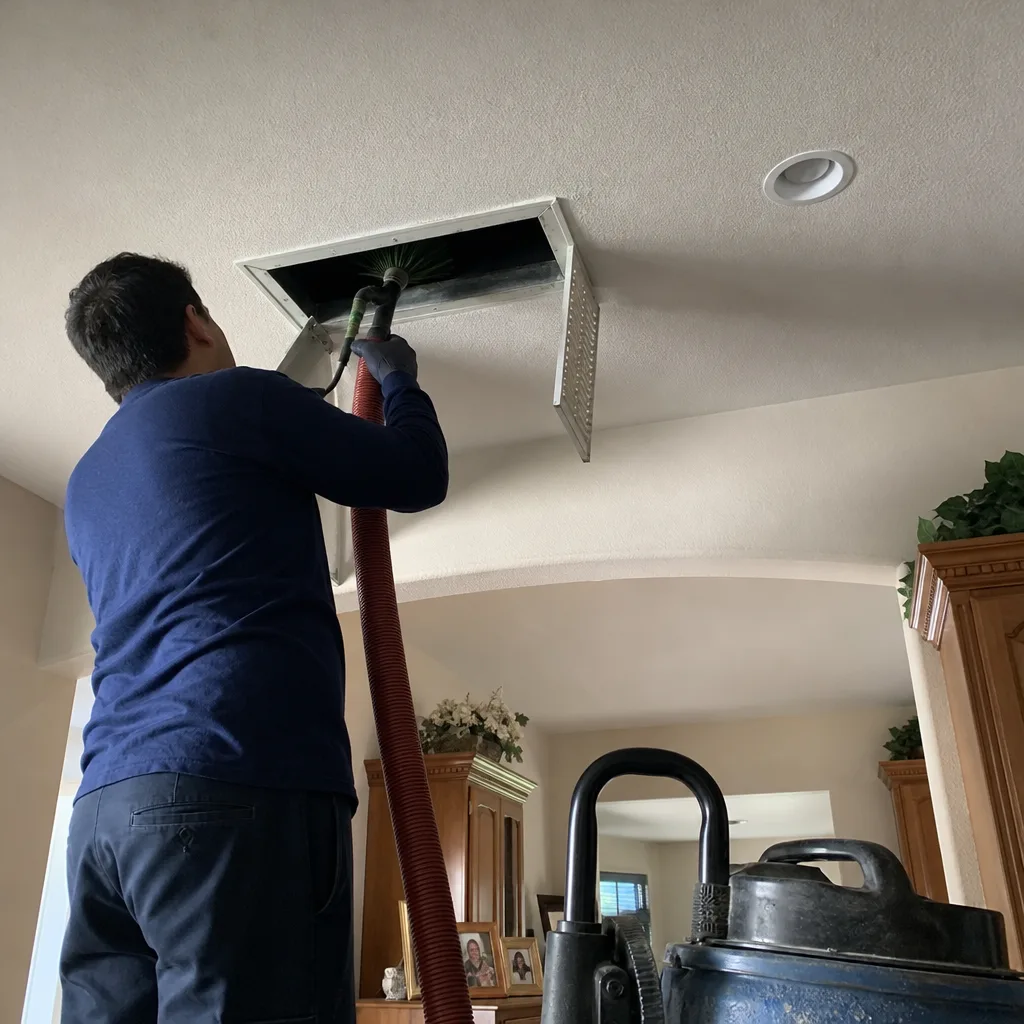
Whole-system duct and dryer vent check with before-and-after photos - you see exactly what came out of your vents
That "$99 whole-house special" is a bait ad - the real number appears once they are in your hallway, or the "clean" is a shop-vac at the register. We photograph the inside of your ducts before and after instead.
The Complete Air Duct Cleaning Guide for Perris Homeowners
Most Perris homes run their HVAC systems 10 to 12 months a year. That’s double the runtime of homes in coastal or northern climates, which means duct contamination accumulates at roughly twice the rate most industry cleaning-interval guidelines assume. Our Complete Guide to Air Duct Cleaning in Perris walks you through exactly what a proper duct cleaning involves, component by component, so you can evaluate any quote with confidence. You’ll learn what the equipment actually does, what gets missed when a tech skips steps, and why our specific climate creates problems a generic national franchise won’t know to look for.
Styles & brands we work with
- Whole-home duct cleaning
- Dryer vent cleaning
- Camera inspection
- Sanitizing & deodorizing
Quick Answer
Air duct cleaning in Perris typically costs between $350 and $700 for a complete single-system clean, depending on home size, number of returns, and how long it’s been since the last service. A proper cleaning involves mechanical agitation of the duct walls paired with HEPA-filtered negative-pressure extraction, not just a vacuum hose poked into a register. Because Perris homes run AC nearly year-round and sit in a region with clay soil dust and seasonal wildfire smoke, most homes here benefit from cleaning every 2 to 4 years rather than the national 5 to 7 year average.
Table of Contents
- Why Perris’s Climate Changes the Duct Cleaning Equation
- The Equipment List Is Your Best Proxy for Job Quality
- What Actually Gets Cleaned: A Component-by-Component Breakdown
- Contact Vacuum vs. Negative-Pressure Extraction: Why the Difference Matters
- Wildfire Smoke, PM2.5, and What It Does to Flex Duct
- How to Read an Inspection Report: Dust vs. Biological Growth
- Realistic Cleaning Intervals for Perris Homes
- Common Mistakes to Avoid
- When to Call a Professional
- Frequently Asked Questions
- The Bottom Line
Why Perris’s Climate Changes the Duct Cleaning Equation
Perris sits in the Perris Valley, surrounded by agricultural land, dry lake beds, and the kind of fine clay soil that turns to airborne powder the moment it dries out. When the Santa Ana winds kick up, that dust doesn’t just settle on your patio furniture. A portion of it gets pulled into your return registers every time your AC cycles on, which in a Perris summer means dozens of times per day.
Here’s the thing about flex duct, which is what most Perris homes have running through their attics. Flex duct has a corrugated interior surface, not a smooth metal wall. Those ridges create turbulence as air moves through, and turbulence causes particulate to drop out of the airstream and cling to the duct lining. The dustier your environment, the faster that lining loads up. In a coastal city with 6 months of mild weather and a sealed attic, that buildup is slow. In Perris, where we see dust, agricultural particulate, and extended AC runtimes, the same duct can load up in half the time.
We’ve also seen what happens after heavy rains follow dry periods, which is the normal pattern here. Dust that accumulated in attics gets damp, settles, and cakes. Then the first heat wave bakes it into the duct lining. Once that happens, a simple vacuum pass won’t pull it off. It requires mechanical agitation, which we’ll get into below.
For a deeper look at how the Air Duct Cleaning in Perris process addresses these local conditions, that page covers our full step-by-step. But the short version is this: the cleaning method has to match the contamination pattern, not just the square footage.
The Equipment List Is Your Best Proxy for Job Quality
Most homeowners evaluate Air Duct Cleaning services on price. That’s a mistake, and here’s why: your ducts are only as clean as the equipment cleaning them. A tech with a consumer-grade vacuum and a basic brush can charge half what a properly equipped crew charges, but they’re not doing the same job. Not even close.
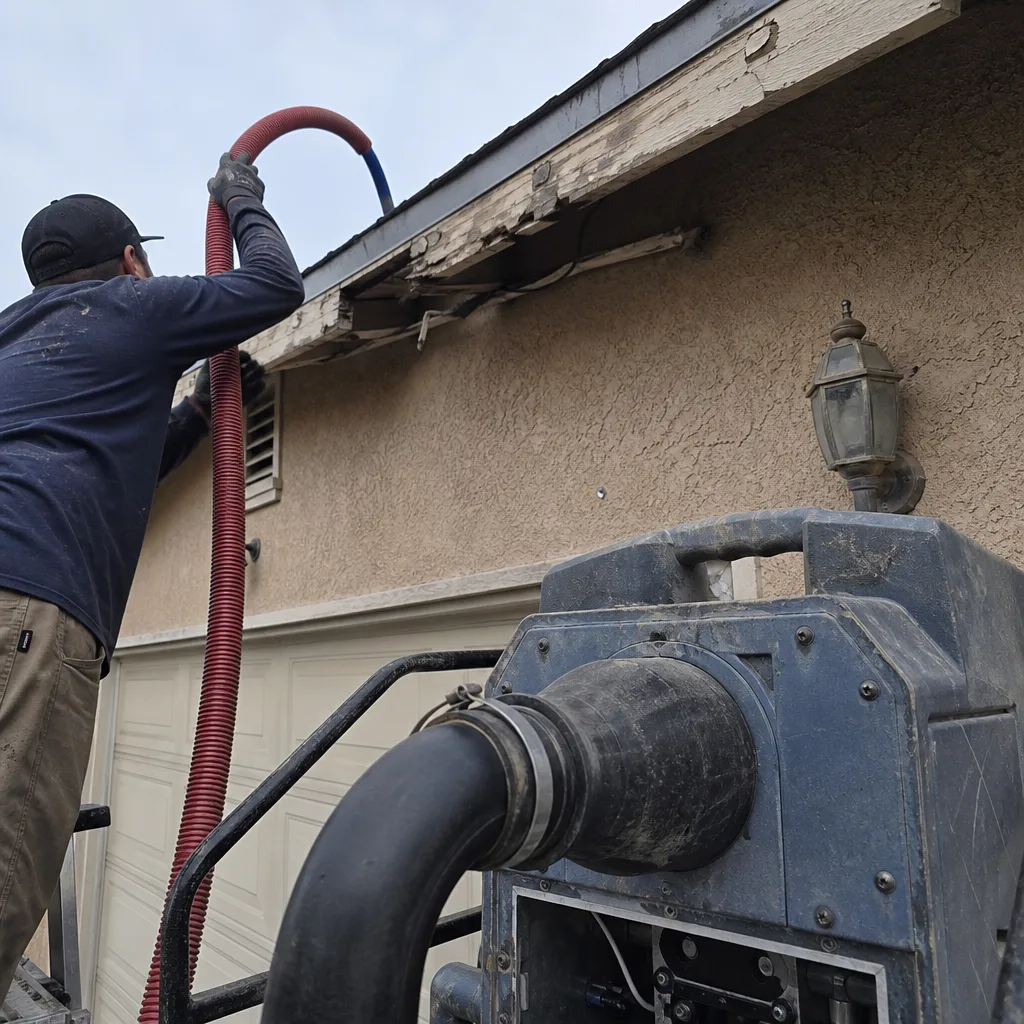
Professional-grade duct cleaning in the Perris market generally falls into two camps. The first is the truck-mount vacuum approach, where a large diesel or PTO-driven vacuum creates suction at a single point. The second, and the one we use, pairs a HEPA-filtered extraction system with mechanical brush agitation. The brand names matter because they represent different performance classes. A Nikro HEPA system captures particles down to 0.3 microns and is built for negative-air applications, meaning it holds the duct system under constant negative pressure while dislodged debris is pulled out. A Rotobrush system provides the agitation component: a spinning brush head that physically scrubs the corrugated walls of flex duct, breaking loose the caked dust that a vacuum alone will leave behind.
Here’s the specific difference, because it’s the single most important thing a homeowner can ask about. A vacuum-only clean, whether truck-mount or portable, creates suction but relies on the airstream itself to lift debris. Loose dust gets pulled out. But anything adhered to the duct walls, anything caked by humidity, anything sticky from aerosolized cooking oils, stays put. The tech runs the vacuum for 45 minutes, shows you a filter full of dust, hands you an invoice, and leaves 40% of the contamination in place. We’ve followed behind enough of those jobs in Perris to know the pattern.
If you get a quote, here’s what to ask: “What equipment are you bringing?” and “Do you agitate the duct walls or is it vacuum-only?” A legitimate company will answer both questions without hesitation. If the answer on agitation is vague, that’s your signal to keep looking.
What Actually Gets Cleaned: A Component-by-Component Breakdown
A proper whole-system duct cleaning in a Perris home touches every component of the air path, not just the visible registers. Here’s the full list, in the order a competent crew works through it. Each step matters. Skip one and you’ve left a portion of the system dirty enough to re-contaminate the rest.
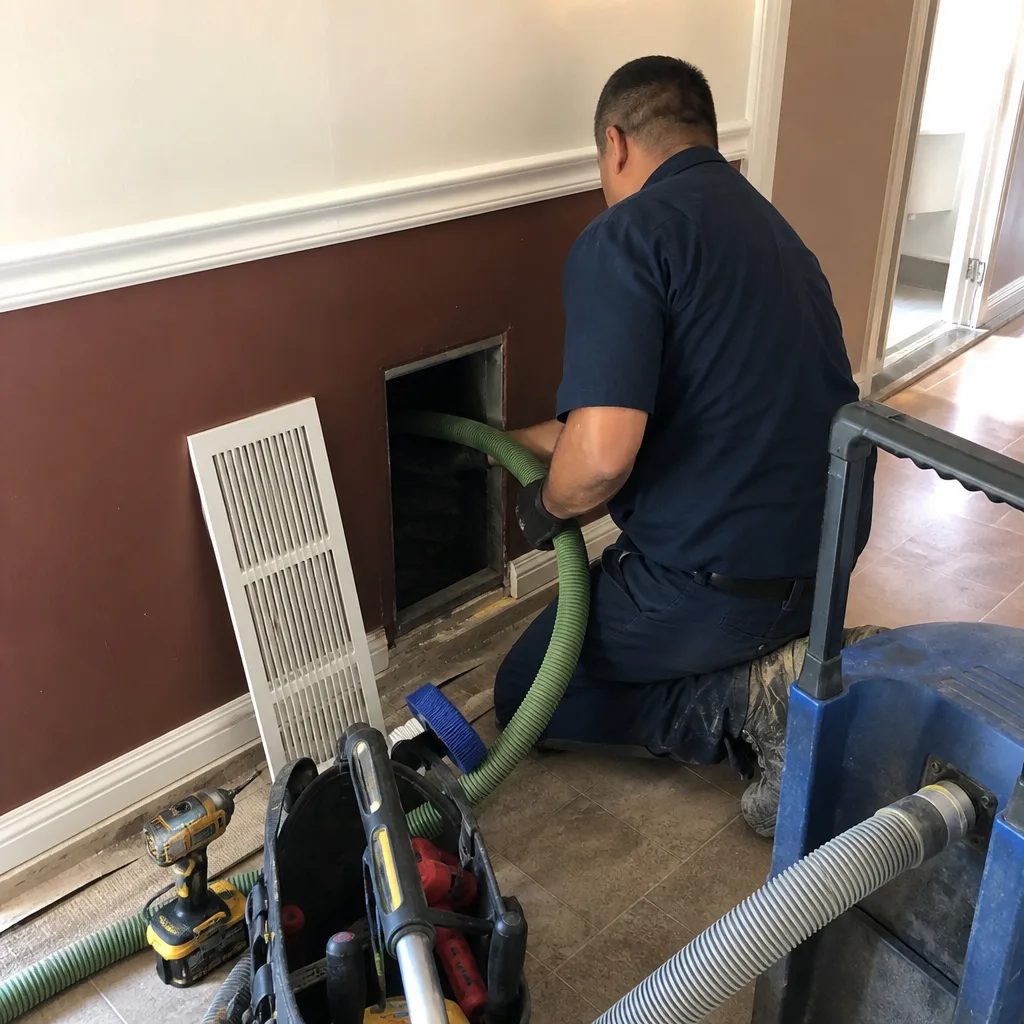
- The supply registers and boots. These are the metal or plastic housings behind every vent cover. Technicians remove each cover, clean it, then scrub the boot interior. This is the first thing a homeowner sees, but it’s actually the least contaminated part of the system because supply air is filtered before it enters the ductwork.
- The return registers and boots. This is where the dirt enters. Return air is pulled from your living space before it hits the filter, so return boots accumulate hair, dust, and debris at a much higher rate than supply components. In Perris homes with pets, return boots often hold significant pet hair matting.
- The main trunk lines. The large rectangular or round ducts running through your attic or crawlspace. These carry the highest air volume and the deepest accumulations, especially along the bottom where gravity settles particulate. Mechanical agitation matters most here.
- The branch runs. The flex duct lines that branch off the trunk to serve individual rooms. These have the corrugated interior we mentioned earlier and are typically the most contaminated part of a Perris system because of the particulate drop-out effect.
- The air handler or furnace cabinet. The blower motor, blower wheel, evaporator coil (if accessible), and interior cabinet surfaces. A cleaning that skips the air handler leaves the fan blowing across dirty surfaces, which immediately re-contaminates cleaned ducts.
- The filter housing and filter. The filter itself gets replaced, but the housing around it matters too. Bypass air leaking around a poorly seated filter is a major source of dust entering the system regardless of filter quality.
What gets skipped by a rushed tech? The air handler cabinet, almost always. It’s the most time-consuming component and the least visible to the homeowner, which makes it the easiest corner to cut. If a quote seems suspiciously low, ask specifically: “Does that price include the air handler cabinet and blower wheel?” We cover that and related work in our Air Duct Repair in Perris service, because structural damage often gets found during the cleaning process.
Contact Vacuum vs. Negative-Pressure Extraction: Why the Difference Matters
Let’s get technical for a moment, because this is the difference between cleaning ducts and just moving dust around. There are two fundamentally different approaches to duct cleaning, and they do not produce the same result.
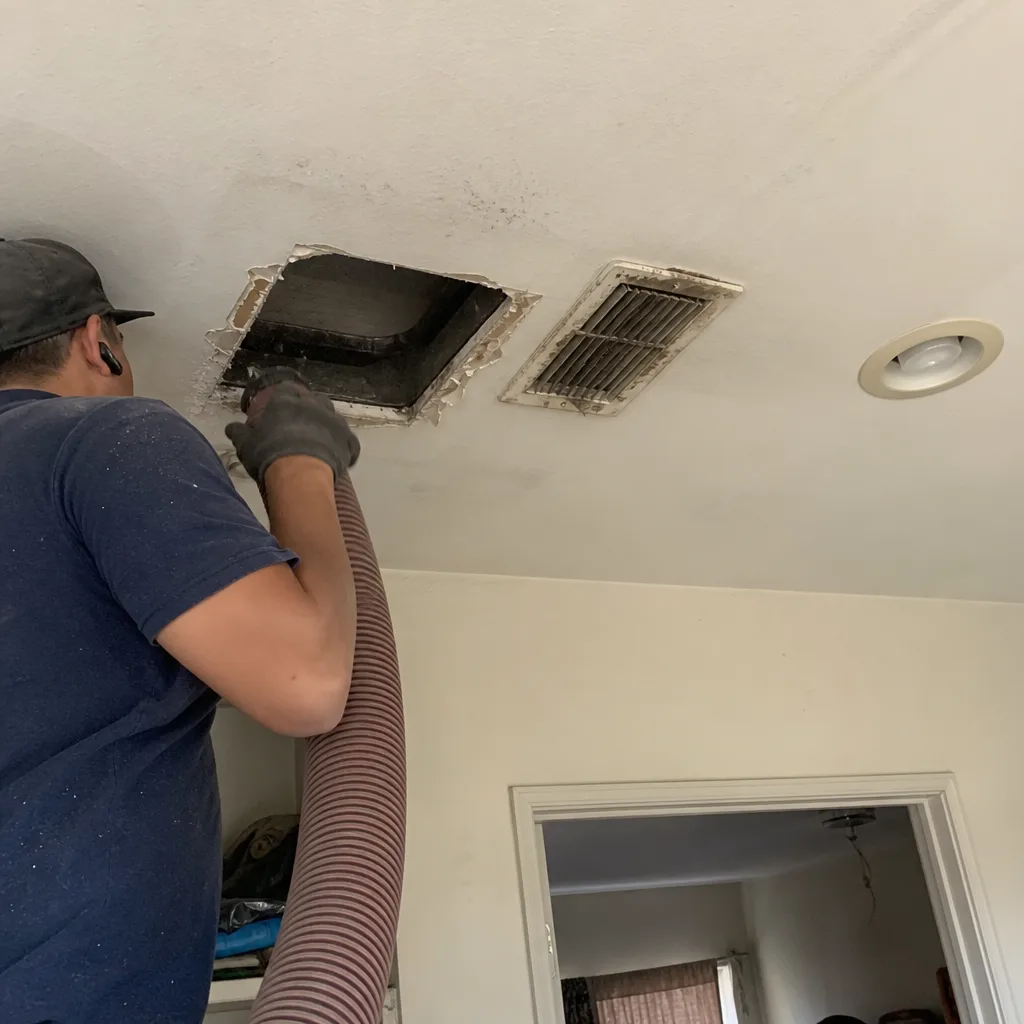
Contact vacuuming is what it sounds like: a vacuum hose inserted through each register, as far as it will reach, without sealing the system. The vacuum creates localized suction, but air is also being pulled from the room through the same register. The system is open. Debris loosened by the vacuum or a brush can escape into the living space. Worse, the vacuum only pulls air from the immediate area around the hose tip. Everything else in the duct run stays exactly where it was.
Negative-pressure extraction works differently. The tech seals the system at key points, then connects a HEPA-filtered vacuum system (like a Nikro unit) to create continuous negative air pressure inside the ductwork. Every supply and return is sealed except the one being actively worked. This means any particulate dislodged during agitation gets pulled into the vacuum stream, not blown into your home. The HEPA filtration ensures what goes through the vacuum doesn’t come back out the exhaust. Meanwhile, the Rotobrush agitation head works inside the ducts, mechanically scrubbing surfaces while the negative pressure pulls dislodged debris toward capture.
From the homeowner’s perspective, negative-pressure extraction is the difference between a service that leaves your house dustier and one that leaves your air genuinely cleaner. It’s also the standard used in professional remediation environments. The equipment matters because the physics matters. Abatement Technologies containment and filtration gear, used in professional remediation work, follows the same principle: contain, capture, and remove rather than simply disturb. That’s the standard we work to, not the standard of a basic maintenance call.
Wildfire Smoke, PM2.5, and What It Does to Flex Duct
Perris sits downwind of wildfire territory in the San Bernardino Mountains and the wider Inland Empire. When fires are active, smoke carries fine particulate matter, specifically PM2.5, which are particles 2.5 microns or smaller. That’s small enough to pass through most standard 1-inch HVAC filters without being captured.
Here’s what that means for your ducts. PM2.5 particles from wildfire smoke enter your return air stream, pass through your basic fiberglass or low-MERV filter, and circulate through your duct system. A portion of those particles deposits on the interior duct walls, particularly in the flexible branch runs. The deposition is slow during a single smoke event, but cumulative. We’ve seen homes in the Lake Perris area where post-fire inspections showed visible soot deposition in supply runs that had been cleaned only two years prior.
The interaction with your existing duct dust matters too. PM2.5 tends to be sticky. It binds with the dust already in your ducts and forms a layer that’s harder to remove than plain household dust. That’s why after a major smoke season, a cleaning that only uses vacuum extraction without mechanical agitation often fails. The smoke-affected layer stays put.
For homeowners who want to address the filtration side before the next smoke season, installing a higher-MERV filtration system matters. We install and service Honeywell and Aprilaire air-quality products, which are designed to handle exactly this type of fine particulate load. A Honeywell media cabinet with a MERV 11 or MERV 13 filter captures a meaningful percentage of wildfire PM2.5 at the return before it ever reaches your ducts. That doesn’t eliminate the need for duct cleaning, but it shifts the accumulation rate significantly.
How to Read an Inspection Report: Dust vs. Biological Growth
After any duct cleaning in Perris, you should receive inspection documentation. Before-and-after photos are the minimum. A proper company will also walk you through what they found. But reading the findings correctly matters, because dust and biological growth are very different problems with very different solutions.
Ordinary dust accumulation looks gray, brown, or tan. It sits loose or lightly adhered to duct surfaces, concentrated along the bottom of horizontal runs and in return boots. It’s composed of dead skin cells, pet dander, textile fibers, and local dust from clay soil and agricultural particulate. Normal. Expected. And the thing your cleaning just removed.
Biological growth looks different. It appears as black, dark green, or slimy patches, often patterned like spotting or webbing. It may be visible on the evaporator coil, the plenum, or in areas where condensation has been persistent. In the Perris climate, the most common trigger is an oversized AC unit that runs short cycles and never fully dehumidifies, leaving the coil box and plenum damp. Another trigger is a duct run in an unventilated crawlspace where condensation forms on the exterior and wicks inward. Biological growth requires a different remediation path: source removal, moisture correction, and in many cases replacement of affected materials. A duct cleaning alone won’t solve it, and any company that tells you otherwise isn’t being straight with you.
The reason this matters for Perris homeowners evaluating an inspection report: you need to know which problem you have before you spend money on a solution. If the report shows ordinary dust and the tech recommends cleaning, that makes sense. If the report shows suspected biological growth and the tech offers the same cleaning, get a second opinion. The Duct Cleaning Perris home guide covers our inspection approach, and we always flag anything we see that’s outside the scope of a standard cleaning.
Realistic Cleaning Intervals for Perris Homes
The national guideline you’ll hear is “every 3 to 5 years.” That’s a starting point, not a rule. In Perris, the interval depends on several specific factors, and here’s how we break it down in practice.
A newer home with a tight building envelope, a quality MERV 8 or higher filter, no pets, and an HVAC system that runs clean can often go 3 to 4 years between cleanings. That’s the low-contamination scenario.
A typical Perris home with two pets, a standard 1-inch fiberglass filter, and the kind of ambient dust we get from clay soil and agricultural land should plan on 2 to 3 years. The return boots will tell you before that: take a look at one with a flashlight every few months. If you can see visible dust caking around the return opening, the ducts behind it are building up too.
Post-wildfire smoke exposure changes the math. If you’ve experienced a smoke event significant enough that you noticed the smell indoors, plan to clean or at minimum inspect within 6 to 12 months. The soot deposition from a single heavy smoke year can accelerate buildup dramatically, particularly in flex branch runs.
Older homes with original flex duct, which includes many houses in central Perris built in the 1980s and 1990s, should be inspected annually. Flex duct deteriorates over time. The inner liner can separate from the insulation layer, creating voids where particulate collects and won’t come out with any cleaning method. If your flex duct is 20+ years old, the question may not be when to clean but when to replace, which falls under our Air Duct Repair in Perris scope.
Common Mistakes to Avoid
- Judging by price alone. The cheap whole-house special almost always means vacuum-only, no agitation, no sealing, and skipped components. You get a receipt and not much else. Ask what equipment is being used before you compare prices.
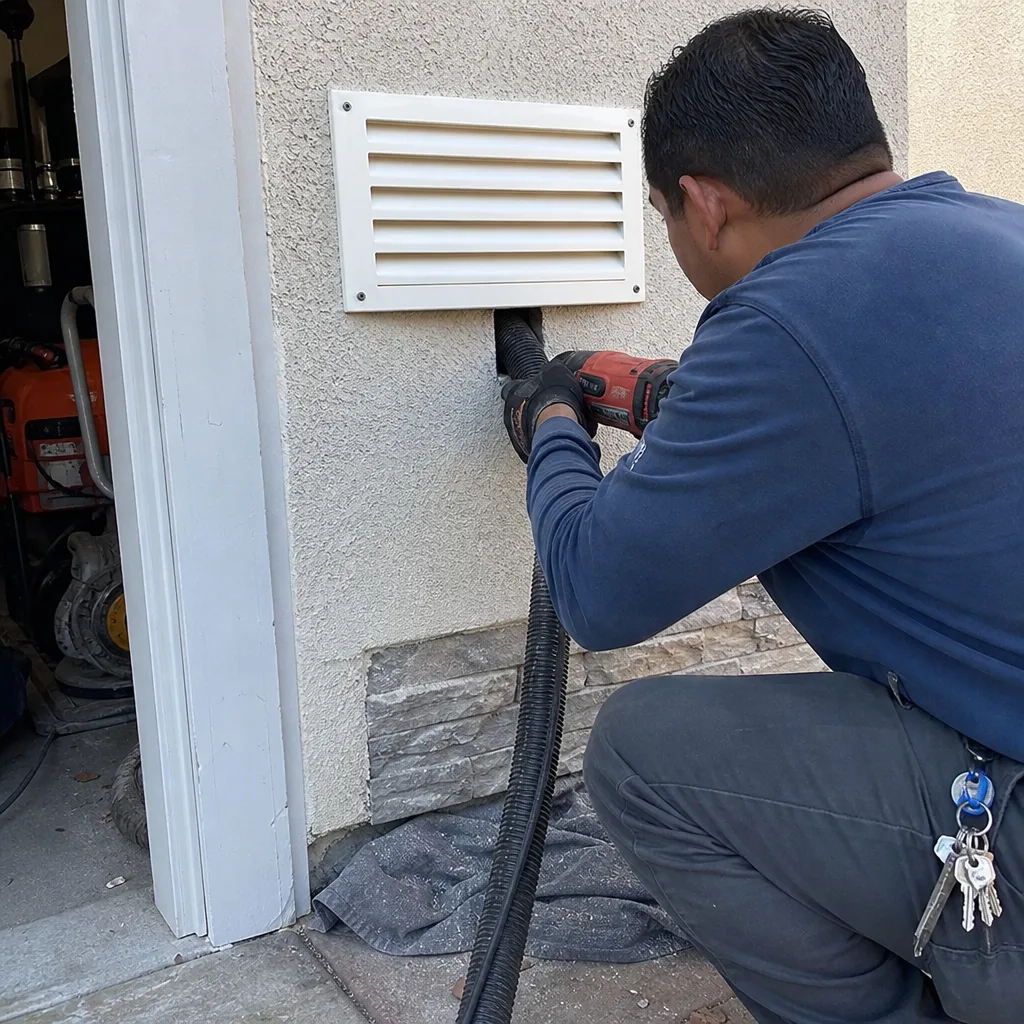
- Treating dryer vents as an afterthought. A dryer vent isn’t a minor add-on. It’s a fire-hazard service. Lint accumulation in the exhaust line is the leading cause of residential dryer fires in the US, and Perris homes with long vent runs through attics are at higher risk. Dryer Vent Cleaning in Perris should be scheduled on its own merits, not tacked on as a discount.
- Assuming a DIY vacuum pass is enough. You can’t clean what you can’t reach. A homeowner with a shop vac can pull loose debris from the first foot of a return boot. Everything beyond that stays put. Professional-grade equipment, not shop-vac shortcuts, is the only way to address the full duct run.
- Skipping the air handler cabinet. If the blower wheel is caked and the tech never opens the cabinet, the first AC cycle after cleaning blows that dust right back into your freshly cleaned ducts. Always confirm the air handler is included in the scope.
- Confusing dust with mold. Dark dust isn’t necessarily biological growth, and biological growth isn’t solved by cleaning. Get a proper inspection and understand what the report is telling you before you spend on a solution.
- Treating post-renovation dust as optional to address. If you’ve had drywall work, flooring replacement, or any construction in a Perris home, drywall particulate is in your ducts. Drywall dust is abrasive and fine enough to bypass basic filters. Get the system cleaned after construction, not during the next maintenance cycle.
- Assuming a high-MERV filter solves everything. A better filter slows accumulation. It doesn’t remove what’s already in the ducts, and in an under-serviced system, the increased pressure drop can reduce airflow. Use filtration as maintenance, not as a substitute for cleaning.
When to Call a Professional
Call for a professional inspection if you’ve lived in your Perris home for three or more years without a duct cleaning, if you’ve had renovation work done and can see dust around your registers afterward, if your return boots show visible caking, or if you’ve experienced a smoke event where the odor was noticeable indoors. Also call if your energy costs have increased without explanation; restricted airflow from loaded ducts forces the blower to work harder. For DIY vs Professional Air Duct Cleaning: The Perris Homeowner’s Decision Guide, or to schedule service, call Duct Cleaning Perris at (844) 728-0966 for a free estimate.
Frequently Asked Questions
Air duct cleaning in Perris typically runs between $350 and $700 for a complete single-system clean, with larger homes or heavily contaminated systems at the higher end. The variables are home size, number of return registers, accessibility of the air handler, and time since the last cleaning. Call (844) 728-0966 for an exact quote.
Cheaper quotes almost always mean vacuum-only cleaning without mechanical agitation, no system sealing, and skipped components like the air handler cabinet. The job takes less time and less equipment, so the price is lower, but a meaningful portion of the contamination stays in place. Ask what equipment is being used before you compare prices.
Ask for before-and-after photos of the key components: return boots, trunk line interior, and air handler cabinet. A legitimate company will provide them without hesitation and walk you through what changed. If a company refuses photos or only shows you a bag of debris, that’s not verification of what was cleaned in your ducts.
Most Perris homes need cleaning every 2 to 4 years, compared to the national 5 to 7 year average. The accelerated rate comes from year-round AC runtime, fine dust from clay soil and agricultural particulate, and occasional wildfire smoke deposition. Homes with pets or older flex duct should lean toward the shorter interval.
Duct cleaning can reduce the recirculation of accumulated allergens like dust mites, pet dander, and pollen that have settled in the system, which may help allergy symptoms. However, it’s not a cure. Pairing a clean system with a quality filtration upgrade, like a Honeywell or Aprilaire unit, addresses the airborne particulate at the return before it recirculates.
Duct cleaning addresses the HVAC system’s supply and return air paths. Dryer vent cleaning addresses the exhaust line from your clothes dryer to the exterior vent cap, removing lint that creates a fire hazard. They’re separate services with separate equipment and separate labor. A dryer vent isn’t a minor add-on; it’s a fire-hazard service that deserves its own visit.
The Bottom Line
Duct cleaning in Perris is a local service with local variables. Our climate loads duct systems faster than national guidelines assume. Our dust composition, including clay particulate and seasonal smoke deposition, adheres more stubbornly than the loose household dust a vacuum can handle. And our older housing stock often includes flex duct that’s been in service for decades. The right approach is professional-grade equipment for both agitation and HEPA extraction, a full system scope that includes the air handler, and an honest inspection that tells you whether you’re dealing with ordinary dust or something that needs a different solution. Clean, inspect, repair: one visit, one contractor. That’s how it should work in your Perris home.
Written by the team at Duct Cleaning Perris, serving Perris since 2014. Explore more guides & resources on our blog.
See the difference
 Before
 After
 Before
 After
 Before
 After