
Last updated November 2, 2026
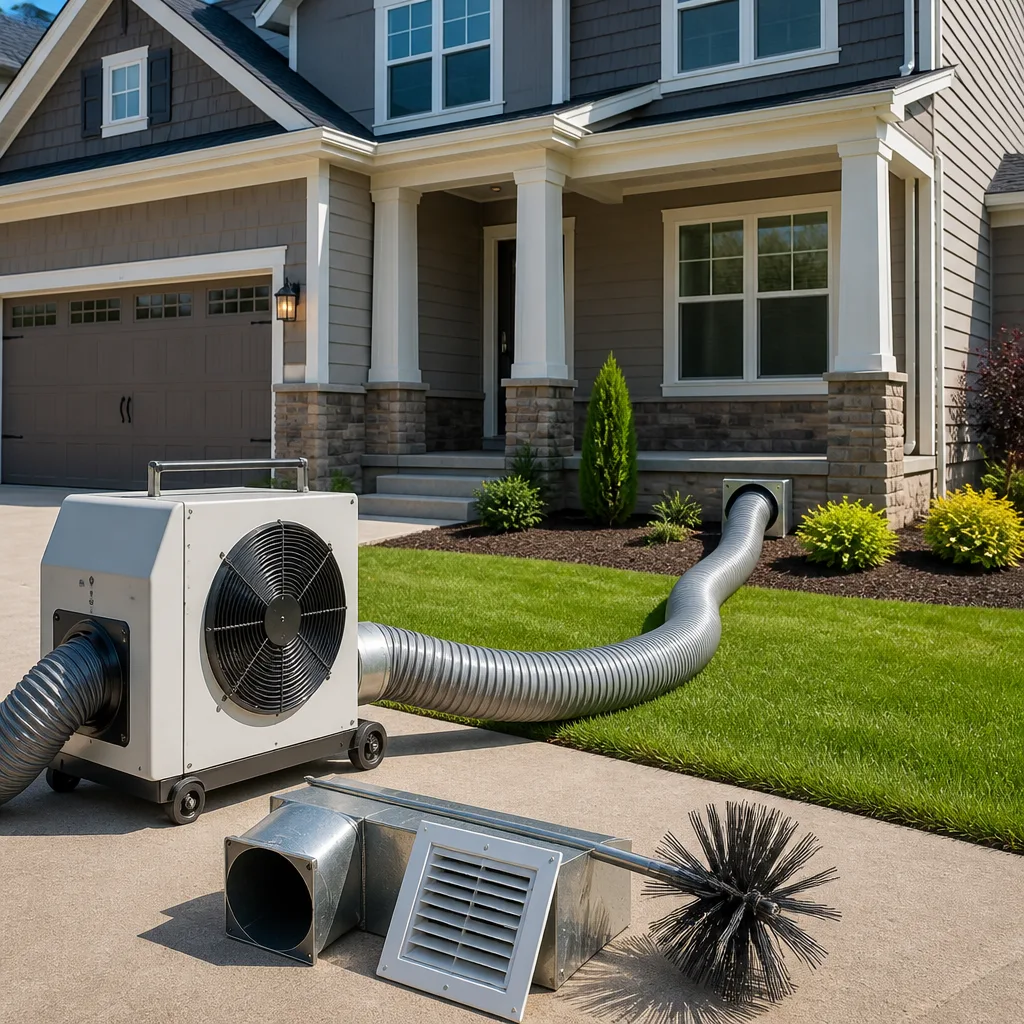 Whole-home duct cleaning
 Dryer vent cleaning
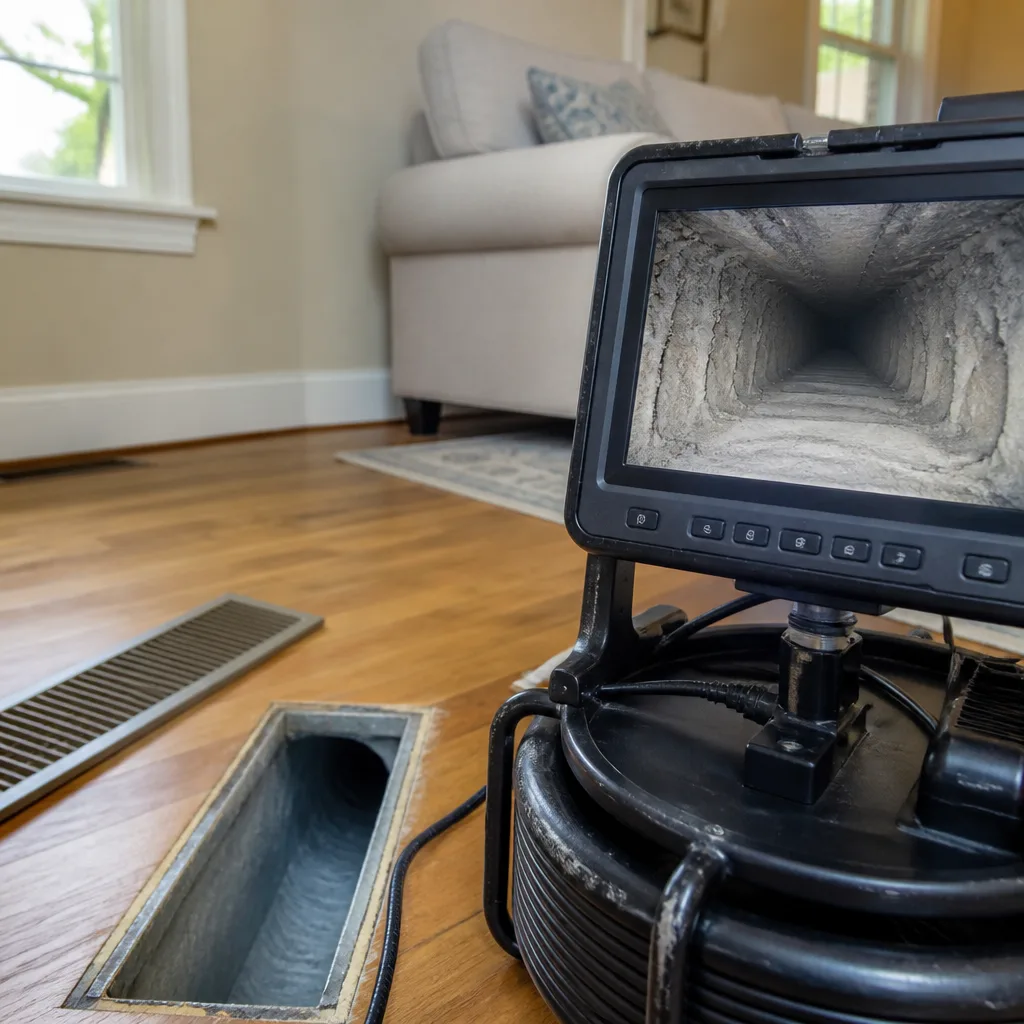 Camera inspection
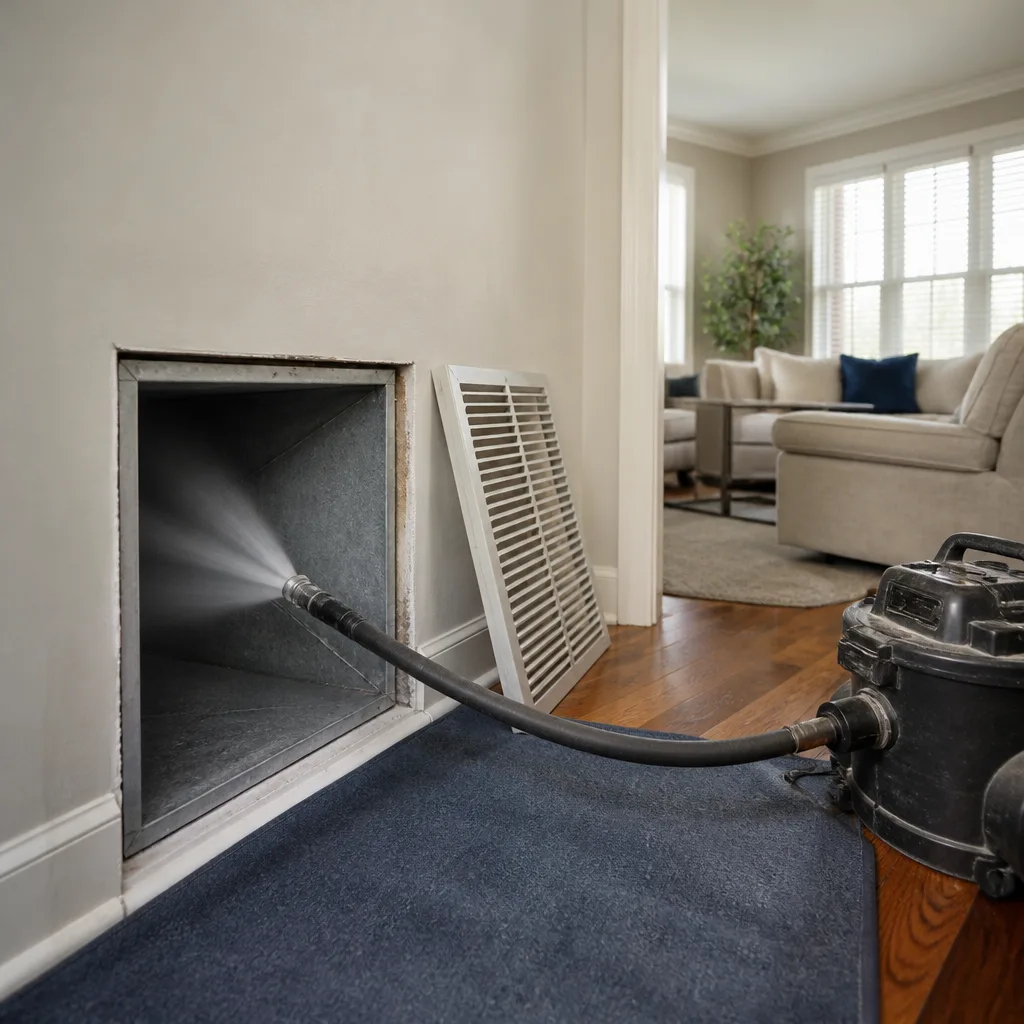 Sanitizing & deodorizing
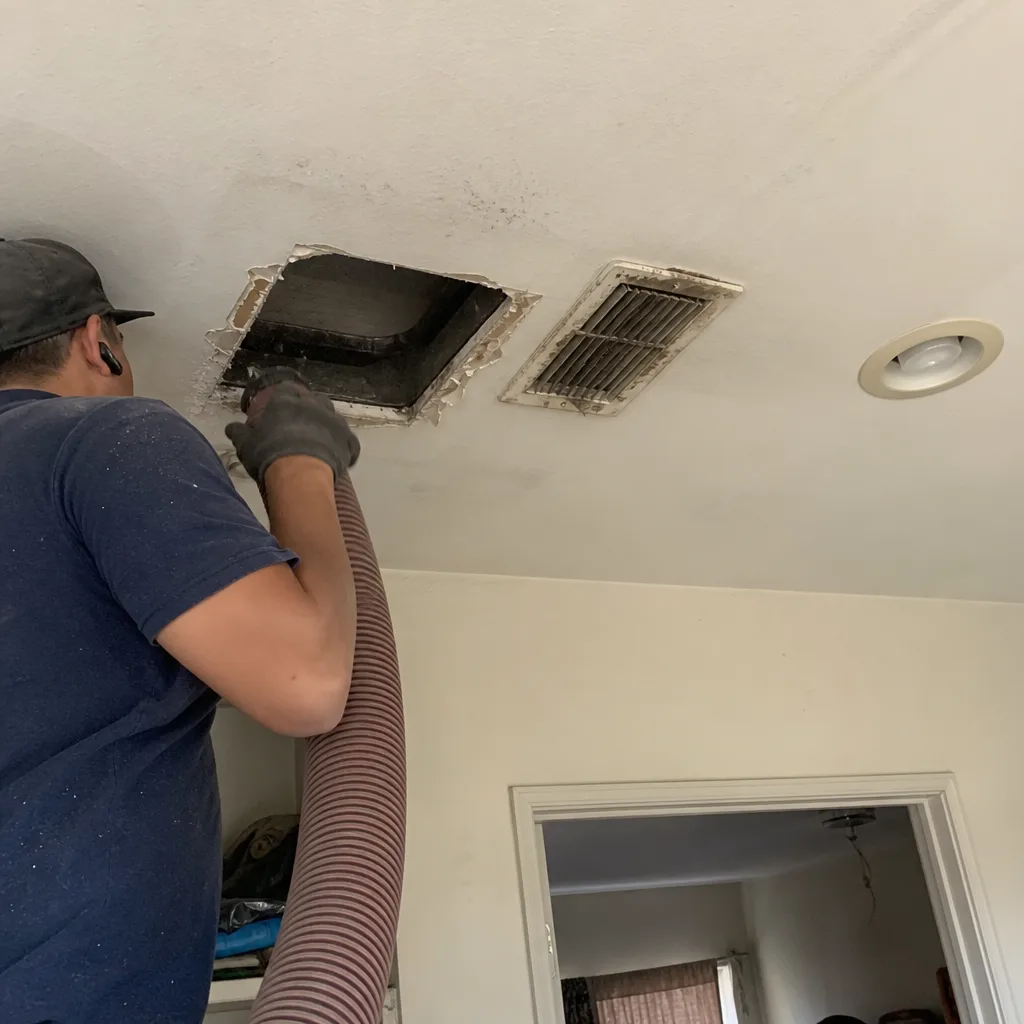
Whole-system duct and dryer vent check with before-and-after photos - you see exactly what came out of your vents
That "$99 whole-house special" is a bait ad - the real number appears once they are in your hallway, or the "clean" is a shop-vac at the register. We photograph the inside of your ducts before and after instead.
Seasonal Air Duct Cleaning Care for Perris: Year-Round Homeowner’s Guide
The worst time to discover your ducts are full of debris is the first 100°F day in June, when your system runs 14 hours straight and pushes every bit of it through your living space at once. That’s not a hypothetical for Perris homeowners. It’s an annual event. The Inland Empire’s heat cycle doesn’t just strain your AC unit. It turns your ductwork into a distribution network for whatever has accumulated since the last time anyone looked inside. This guide maps duct care to Perris’s actual seasonal patterns: the punishing summer run, the Santa Ana dust events, and the mild winter that quietly sets up next year’s problems.
Quick Answer
Seasonal Air Duct Cleaning in Perris means timing service around three real events: pre-summer prep in April or May before the cooling system runs continuously, a post-Santa Ana inspection in October or November after wind-driven dust intrusion, and an annual professional cleaning with brush-agitation and HEPA extraction rather than a shop-vac shortcut. Homeowners who follow this schedule catch flex duct degradation, filter saturation, and debris buildup before they become system-wide problems.
Styles & brands we work with
- Whole-home duct cleaning
- Dryer vent cleaning
- Camera inspection
- Sanitizing & deodorizing
Table of Contents
- Why Perris’s Climate Demands a Different Duct Care Schedule
- The Month-by-Month Action Map for Perris Homeowners
- Attic Duct Reality: Heat, Degradation, and What to Look For
- Santa Ana Wind Events and Duct Contamination
- Seasonal Filter Strategy: Why MERV 8 Isn’t Enough in July
- Sequencing HVAC Maintenance So the Work Doesn’t Undo Itself
- Why Equipment Matters: Brush Agitation vs. Suction-Only Cleaning
- When Cleaning Reveals Damage: The Repair Conversation
Why Perris’s Climate Demands a Different Duct Care Schedule
Perris sits in a thermal trough that produces some of the most sustained heat in Southern California. July and August routinely push past 100°F, and unlike coastal cities that cool off at night, Perris often stays warm well past midnight. That means your HVAC system doesn’t get the overnight recovery period that systems in Temecula or Murrieta enjoy. It runs, cycles off briefly, and runs again. The ductwork becomes a permanent conveyor belt of conditioned air moving through attic spaces that can reach 140°F or higher.
That sustained runtime changes the math on how quickly ducts accumulate debris. A system that runs 8 hours a day in a moderate climate collects dust at one rate. A Perris system running 14 to 16 hours a day from June through September is pulling air through the return, across the filter, over the coil, and out through the supply ducts at double that rate. Every cubic foot of air carries particulates. More runtime means more total particulates moving through the system, which means more accumulation on duct walls, registers, and the blower assembly.
This is why a generic “clean your ducts every 3 to 5 years” rule fails in Perris. The runtime multiplier compresses that interval. We’ve opened ducts in Perris homes that were cleaned three years prior and found a quarter-inch of caked dust on the return trunk. The system had simply moved more air than a coastal equivalent, and the filter hadn’t been upsized to match. Seasonal care in Perris isn’t about following a national guideline. It’s about accounting for local thermal reality.
What This Means for Your Schedule
- Summer is the dominant season. Pre-summer prep matters more than any other single maintenance event.
- Runtime accelerates accumulation. A Perris system may need attention at shorter intervals than a coastal system with identical square footage.
- Attic heat degrades materials. Flex duct liners age faster in Perris attics, which affects both air quality and system efficiency.
The Month-by-Month Action Map for Perris Homeowners
Perris doesn’t have four equal seasons. It has a long cooling season, a short wind season, and a mild winter that can create false confidence. Here’s how to structure duct care around the calendar as it actually operates here, not as a national HVAC blog imagines it. For more guides & resources tailored to local conditions, see our blog.
April – May: Pre-Cooling-Season Preparation
- Schedule professional duct inspection and cleaning. This is the single most important window. You want the system clean before it starts running continuously. If debris is present, you don’t want it baking onto duct walls for four months while the system pushes it through your living space.
- Upgrade your filter. Switch from whatever you ran during winter to a minimum MERV 11 for the cooling season. A MERV 8 filter that was adequate in mild conditions is undersized when the system runs without meaningful breaks. More on filter strategy below.
- Visually inspect supply registers. Remove a register or two and look inside with a flashlight. Grey matting on the duct surface, visible debris, or a musty smell when the blower kicks on are indicators that interior surfaces need attention.
- Check the return plenum. The return side sees all the unfiltered air (or poorly filtered air, depending on your setup) first. If dust is caked on the return grille, that’s a preview of what’s further down the line.
June – September: Peak-Season Monitoring
- Change or inspect the filter monthly. In continuous runtime conditions, a standard 1-inch filter can load up in 30 days. A loaded filter restricts airflow, which makes the blower work harder and can pull air through gaps in the duct system rather than through the return grille.
- Watch for airflow changes. A room that suddenly feels stuffier than others, or a register that’s pushing noticeably less air than it did in May, can signal a duct separation or a major buildup downstream. Don’t wait for October to investigate.
- Listen for new sounds. A whistling register, a rattle that appears only when the system has been running for an hour, or a thump from the attic when the blower cycles off can all be duct-related. Attic heat expands and contracts metal and flex connectors. Joints can separate.
- Note any new dust accumulation. If you’re wiping surfaces more frequently in July than you were in April, your system may be distributing particulates from inside the ducts or pulling air from an attic leak rather than through the filter.
October – November: Post-Santa Ana Inspection
- Inspect registers and the return for wind-driven debris. Santa Ana events push coarse desert dust and, in some years, wildfire ash into homes through every available opening. Your HVAC system can pull this material from the attic environment if there are any return-side leaks.
- Consider an interim cleaning if you experienced significant dust events. A single strong Santa Ana can introduce more particulate into a duct system than six months of normal household dust. If the wind season was particularly active, a fall cleaning may be warranted even if you cleaned in May.
- Check the outdoor condenser. While not ductwork, a condenser clogged with wind-blown debris forces the system to run longer to achieve the same cooling, which in turn pulls more air through the ducts and accelerates re-contamination.
- Evaluate whether the summer did damage. Four months of sustained attic heat can cause flex duct liners to crack or separate. This is the window to catch it before winter heating pushes air through compromised sections.
December: Pre-Heating-Season Check
- Do a final visual inspection before winter runtime. Heating systems run less in Perris than cooling systems, but they still move air. Any debris left from fall should be addressed before the system switches over.
- Keep the same filter discipline. Winter runtime is lower, but the system still cycles. Check the filter monthly and change it when visibly loaded, regardless of season.
- Plan next spring’s cleaning now. If you skipped April – May prep this year, note it. The system will have a full year of accumulated debris by next summer, and the first heat wave is not the time to schedule service.
Perris homeowners who follow this calendar catch problems when they’re small. The alternative, discovering a separated duct or a clogged return in mid-July, means choosing between living with it or scrambling for service during the busiest weeks of the year.
Attic Duct Reality: Heat, Degradation, and What to Look For
Most homes in Perris run their ductwork through unconditioned attic space. That attic is not a neutral environment. In August, attic temperatures can exceed 140°F, and that heat does two things to your duct system. First, it accelerates the degradation of flex duct liners, the plastic inner sleeve that contains airflow. Second, it bakes accumulated dust and debris, making it harder to remove and more likely to flake off into the airstream over time.
Flex duct, the standard material in Southern California residential construction, has an inner liner made of plastic that becomes brittle with repeated heat cycling. After several Perris summers, that liner can develop micro-cracks or separate from the wire coil that gives the duct its shape. When the liner fails, several things happen simultaneously. Conditioned air escapes into the attic instead of reaching your living space. Unfiltered attic air, filled with insulation particles, dust, and whatever else is up there, gets pulled into the return side. And the system has to run longer to achieve the set temperature, which compounds the runtime problem described above.
We regularly see flex duct liner degradation in Perris homes after three to five consecutive hot summers. The visible signs include collapsed sections of duct, visible gaps at connection points, grey dust accumulation on insulation near duct runs, and rooms that never quite reach the set temperature no matter how long the system runs. These are not aesthetic issues. They’re system failures that affect both air quality and energy cost.
What to Look For After Each Summer Cycle
- Sagging or collapsed sections. Flex duct should be pulled taut. A section that dips visibly has likely lost structural integrity.
- Discoloration at joints. Duct tape (the fabric kind, which is incorrectly used on ducts despite the name) dries and fails in attic heat. Mastic-sealed joints are more durable but can still crack.
- Insulation that looks compressed or damp. This can indicate condensation from a liner breach, where hot attic air meets cold conditioned air.
- New dust in the house with no obvious source. If the system is pulling attic air through a return-side leak, that air carries attic dust with it.
The takeaway here is simple: in Perris, duct inspection is not a one-time event. It’s an annual checkpoint because the attic environment is actively working against the materials your duct system is made from. An air duct repair in Perris specialist can assess whether what you’re seeing is cosmetic or structural, but the homeowner who knows what to look for catches problems a year earlier than the one who doesn’t.
Santa Ana Wind Events and Duct Contamination
Santa Ana winds typically hit Perris between September and November, and they don’t behave like ordinary weather. They’re offshore flows that push dry, particle-laden air from the desert toward the coast. In Perris, that means coarse desert dust, and in fire years, wildfire ash from the San Bernardino or San Jacinto mountains. These particulates are mechanically different from the household dust that normally accumulates in ducts. They’re larger, more abrasive, and they enter the system through pathways that normal dust doesn’t use.
During a strong Santa Ana event, outdoor air infiltrates homes through window seals, door gaps, attic vents, and any other opening that isn’t perfectly sealed. Your HVAC system, if it’s running, can pull that air in through return-side leaks that wouldn’t matter under normal conditions. The result is a sharp spike in duct contamination that happens over days, not months. Coarse desert dust is gritty and can lodge in flex duct folds and at connection points where smooth household dust would simply pass through. Wildfire ash is finer and more insidious, distributing itself throughout the system and coating every surface.
This is why a May cleaning doesn’t guarantee clean ducts in December. A single active wind season can undo the work. If you experience one or more significant Santa Ana events, particularly in a year with regional wildfire activity, an interim inspection is worth considering. See our Air Duct Cleaning Emergency Preparedness Guide for Perris Homes for what to watch for, including fine grey or tan dust on surfaces within days of a wind event, a burning smell from the system when it first cycles on after the winds pass, and visible dust accumulation around return grilles that wasn’t there before.
Santa Ana Contaminant Behavior vs. Normal Household Dust
- Coarse desert particulate is heavy and abrasive. It settles in duct bends and at register boots rather than circulating through the living space. It reduces system efficiency and creates future re-contamination when the system cycles.
- Wildfire ash is fine and light. It coats all interior surfaces and resists removal by simple suction. It requires mechanical agitation for effective extraction.
- Normal household dust is primarily skin cells, fabric fibers, and cooking particles. It’s lighter than desert particulate but heavier than ash, and it accumulates gradually rather than in event-driven spikes.
The practical implication: if you’ve had an active Santa Ana season, don’t assume your spring cleaning carried you through. Take a look. The cost of an inspection is modest compared to running a fiberglass-ash mixture through your living space for another year.
Seasonal Filter Strategy: Why MERV 8 Isn’t Enough in July
The MERV 8 filter is a winter filter in Perris. That’s not a judgment on the filter itself. It’s a statement about operating conditions. In winter, when the system runs sporadically and indoor air is relatively stable, a MERV 8 captures the large particles it’s designed to capture without imposing meaningful airflow restriction. In July, when the system runs continuously and is pulling desert dust, attic air, and whatever else is in circulation, a MERV 8 functions less as a filter and more as a coarse screen.
Higher MERV ratings, specifically MERV 11 to MERV 13, capture significantly more of the fine particulate that becomes airborne during sustained runtime. The trade-off is airflow restriction, which is real but manageable if the filter is changed on schedule. A MERV 13 filter that’s left in place for four months becomes a bigger problem than a MERV 8 that’s changed monthly. The strategy is not just selecting a rating. It’s pairing the rating with a change discipline.
A Filter Strategy That Matches Perris Conditions
- Winter (December – February): MERV 8 is acceptable. The system runs less, indoor air is more stable, and the lower restriction is appropriate for lower-volume use.
- Spring transition (March – May): Step up to MERV 11 in April, before peak runtime begins. This catches the early-season dust and gives you a filter that can handle continuous operation.
- Peak summer (June – September): MERV 11 minimum, MERV 13 if you have allergy or air-quality concerns. Check monthly, change when visibly loaded, and never assume a filter is fine because the calendar says it should be.
- Fall (October – November): Stay at MERV 11 or 13 through Santa Ana season. These filters capture wind-driven particulate that a MERV 8 lets through.
The filter is the first line of defense for your duct system and your indoor air. A system running a MERV 8 year-round in Perris is a system that’s allowing preventable particulate into the ductwork, which then requires cleaning to remove. The filter choice is both an air quality decision and a duct longevity decision. Homeowners interested in upgrading beyond basic filter strategies can have whole-home filtration systems installed and serviced. We work with Honeywell and Aprilaire products, which integrate into the existing HVAC system and provide filtration beyond what a standard 1-inch slot filter can achieve.
Sequencing HVAC Maintenance So the Work Doesn’t Undo Itself
Duct cleaning, coil cleaning, and filter upgrades don’t exist in isolation. They’re components of one system, and the order in which you do them matters. A common Perris scenario: a homeowner gets their ducts cleaned in May, then has the evaporator coil cleaned in June, and the coil cleaning blows debris back into the ducts they just paid to have cleaned. Or a homeowner upgrades to a high-MERV filter, restricts airflow, and then wonders why the system seems to be struggling.
The sequence that makes sense is based on how the system actually moves air. Air enters the return, passes through the filter, crosses the blower, passes over the evaporator coil, and exits through the supply ducts. Each component affects the next. Here’s the order that works:
Correct Maintenance Sequence
- Clean the ducts first. This removes accumulated debris from the entire distribution system. If you clean the coil first, you’ll just blow coil debris into clean ducts.
- Clean the evaporator coil second. A coil that’s been running behind dirty ducts has been pulling that dirty air across its fins. Clean it after the ducts are clean so it isn’t re-contaminated by residual debris from the distribution system.
- Upgrade the filter last. Install the new, higher-MERV filter only after all cleaning is complete. A new filter shouldn’t be absorbing the debris you’re about to remove from the system.
- Run the system and verify airflow. After all work is complete, check airflow at each register. If one room is weak, that’s a duct problem, not a filter problem.
This sequencing is rarely followed by homeowners who hire different contractors for different jobs on different days. That’s the argument for a single provider who handles the full duct-system lifecycle. When one contractor cleans the ducts, inspects for damage, and coordinates with the HVAC tech on coil cleaning, there’s no finger-pointing and no undone work. Our air duct cleaning in Perris service includes inspection as part of the process, so damage is identified at the point of cleaning rather than discovered later.
Why Equipment Matters: Brush Agitation vs. Suction-Only Cleaning
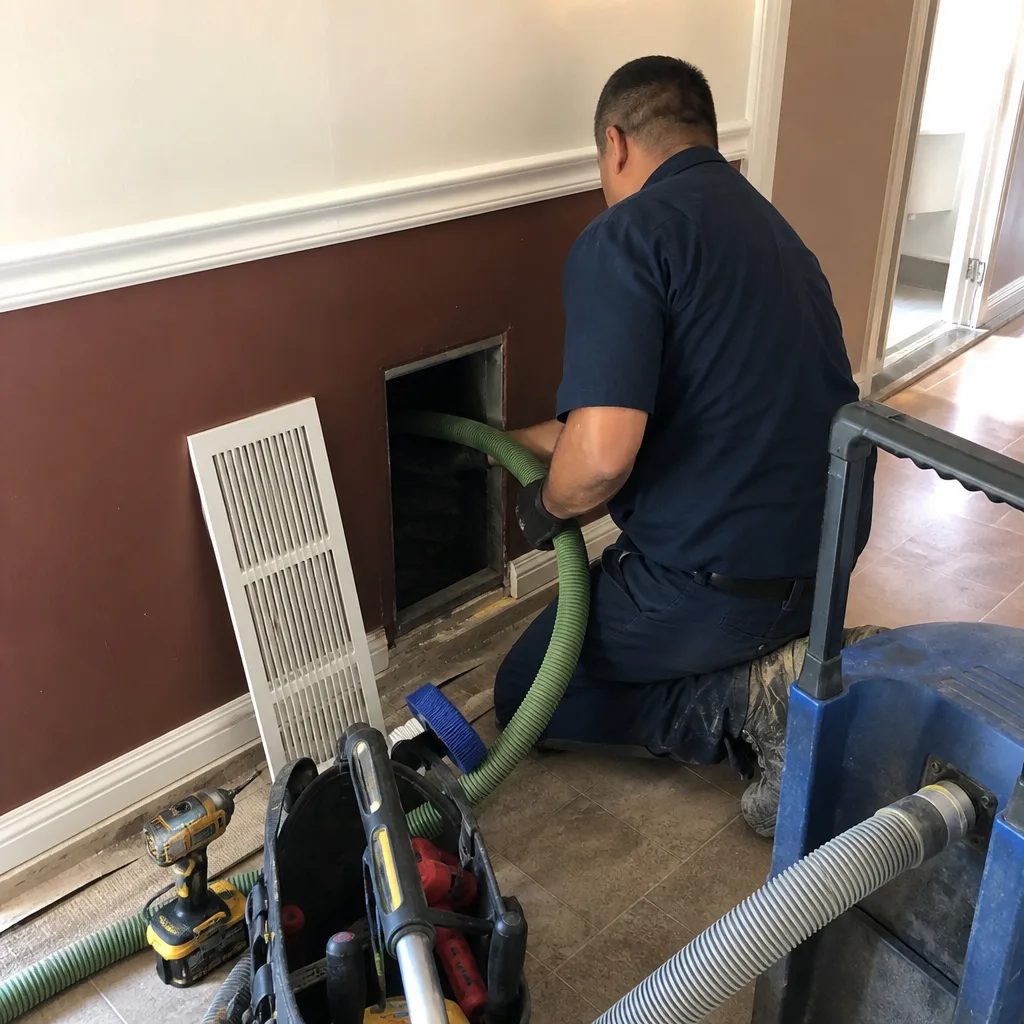
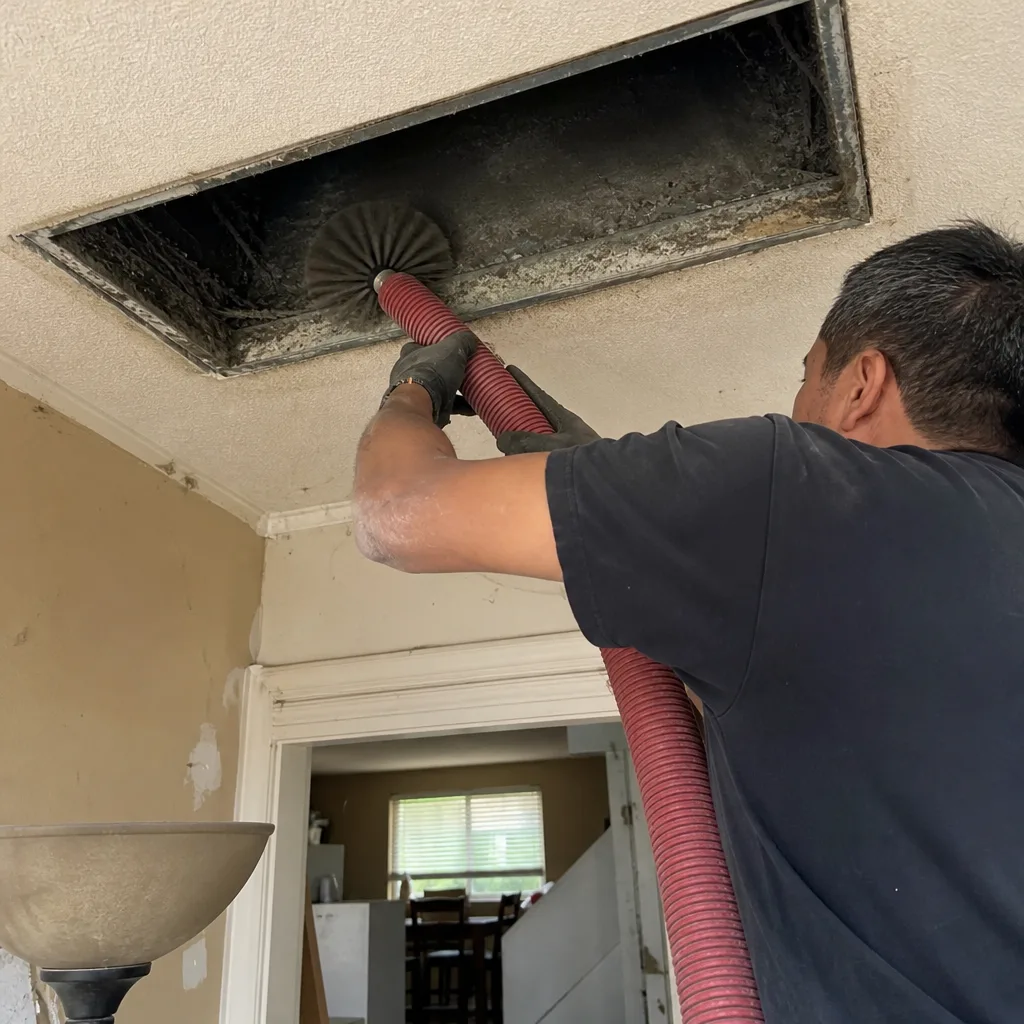
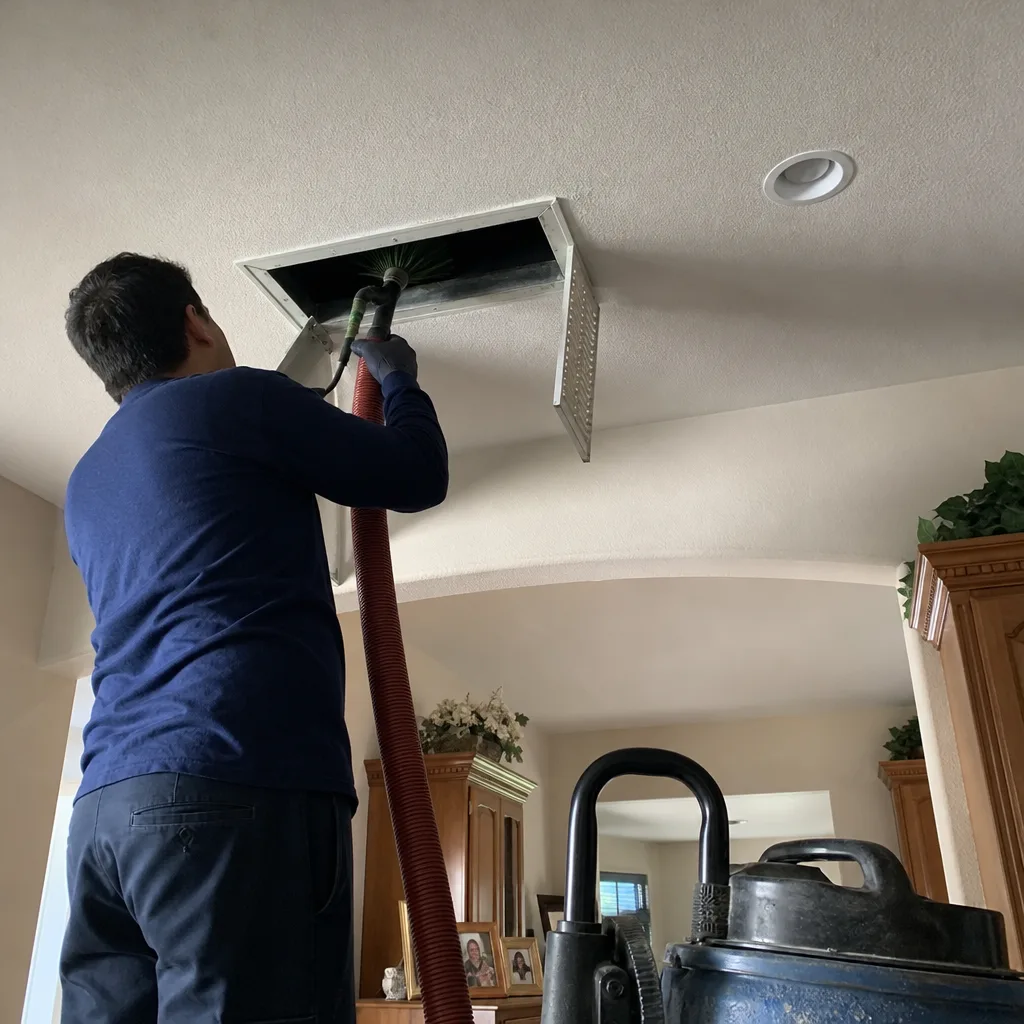
There are two fundamentally different approaches to air duct cleaning, and they produce fundamentally different results. The first is suction-only cleaning, where a vacuum is connected to the system and air is pulled through the ducts. This removes loose debris but leaves anything adhered to the duct walls in place. The second is brush-agitation cleaning, where a mechanical brush moves through the ducts to dislodge accumulated material while a HEPA-rated vacuum captures it. The difference is visible and measurable.
Duct debris in Perris is rarely loose. Months of sustained runtime, combined with attic heat, bakes dust onto duct surfaces. A suction-only pass might remove 60% of the total material, leaving a layer of debris that will flake off over the following months and re-contaminate the system. Brush agitation physically separates that material from the duct walls, and the HEPA extraction system captures it before it can escape into the living space.
This is why equipment brand matters. We run Rotobrush rotary brush systems for mechanical agitation and Nikro HEPA vacuum systems for extraction. These are professional-grade tools designed specifically for duct cleaning. A shop-vac angled into a register is not the same service, and a truck-mount vacuum without brush agitation leaves behind exactly the material that causes the problem. Your ducts are only as clean as the equipment cleaning them. A homeowner who understands the difference between brush-agitation and suction-only is a homeowner who can evaluate quotes intelligently.
What Brush Agitation Achieves That Suction Alone Does Not
- Dislodges baked-on dust that has adhered to duct walls from months of system runtime.
- Reaches debris in flex duct folds where particulate settles and compacts over time.
- Breaks up debris at register boots and connection points where suction alone leaves material behind.
- Provides a cleaner interior surface that stays cleaner longer because residual debris isn’t there to attract more.
When Cleaning Reveals Damage: The Repair Conversation
Duct cleaning is diagnostic by nature. You can’t see inside the system until you’re inside it, and once you’re inside it, you often find things that need attention beyond cleaning. A detached section in the attic, a crushed flex duct under a storage box, a separated joint at a register boot, a gap at the plenum connection. These findings change the conversation from “was it cleaned” to “was it made right.”
This is where the clean-only contractor model fails. A company that shows up, vacuums the system, and hands you a receipt has no incentive to report damage, because reporting damage means extending the job. The full-service model is different. When cleaning reveals a separated duct or a crushed section, the right response is to fix it on the spot. That’s the entire point of inspection. A duct system with a hole in it will re-contaminate within months no matter how thoroughly it’s cleaned.
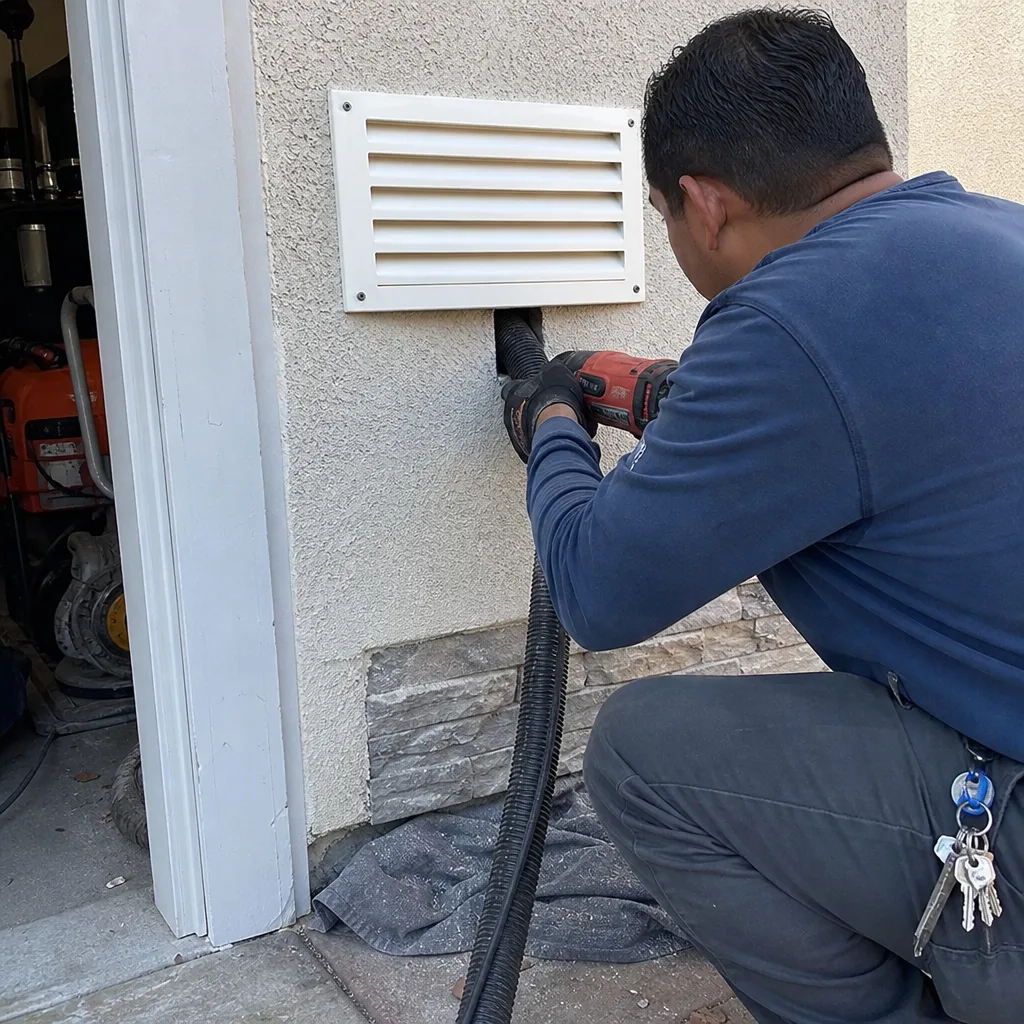
From the duct walls to the filter to the vent cap, the system should be evaluated as a whole. We combine dryer vent cleaning in Perris with duct cleaning and repair, because a dryer vent is not a minor add-on. It’s the difference between a system that moves air efficiently and one that moves lint toward a potential fire hazard. The same inspection that finds a separated duct in the attic can find a lint-packed dryer vent running through the same space. They’re separate problems with the same solution: a contractor who’s actually looking.
If you’re scheduling duct cleaning, ask at the start whether the contractor repairs what they find. If the answer is no, you’re paying for a partial service. Clean, inspect, repair. One visit, one contractor. That’s the model. Our Duct Cleaning Perris home approach is to treat every cleaning as an inspection opportunity, and every inspection as a chance to catch problems before they compound.
Common Mistakes to Avoid
- Cleaning the coil before the ducts. Any debris dislodged from the coil blows into the ducts you haven’t cleaned yet. Sequence matters. Ducts first, coil second, filter upgrade last.
- Running a MERV 8 filter through July. A winter-appropriate filter is undersized for continuous summer runtime in Perris. Step up to MERV 11 or 13 in April and keep it there through Santa Ana season.
- Assuming May cleaning survives the wind season. A single active Santa Ana event can introduce as much particulate as six months of household dust. If you’ve had a significant wind season, inspect before winter heating begins.
- Ignoring attic duct condition because the system “still works.” Flex duct liner degradation in Perris attics is gradual until it’s sudden. By the time airflow fails in a specific room, the liner has likely been compromised for months.
- Paying for suction-only cleaning. Without brush agitation, you’re leaving material behind. If the price seems low, ask what equipment is being used. Professional-grade equipment, not shop-vac shortcuts.
- Skipping the repair conversation. A clean system with a hole in it is an unclean system within months. Make sure your contractor repairs what they find.
- Treating all seasons as equal. Perris is not a four-season climate. Pre-summer prep and post-Santa Ana inspection are the two events that matter. Everything else supports those.
See the difference
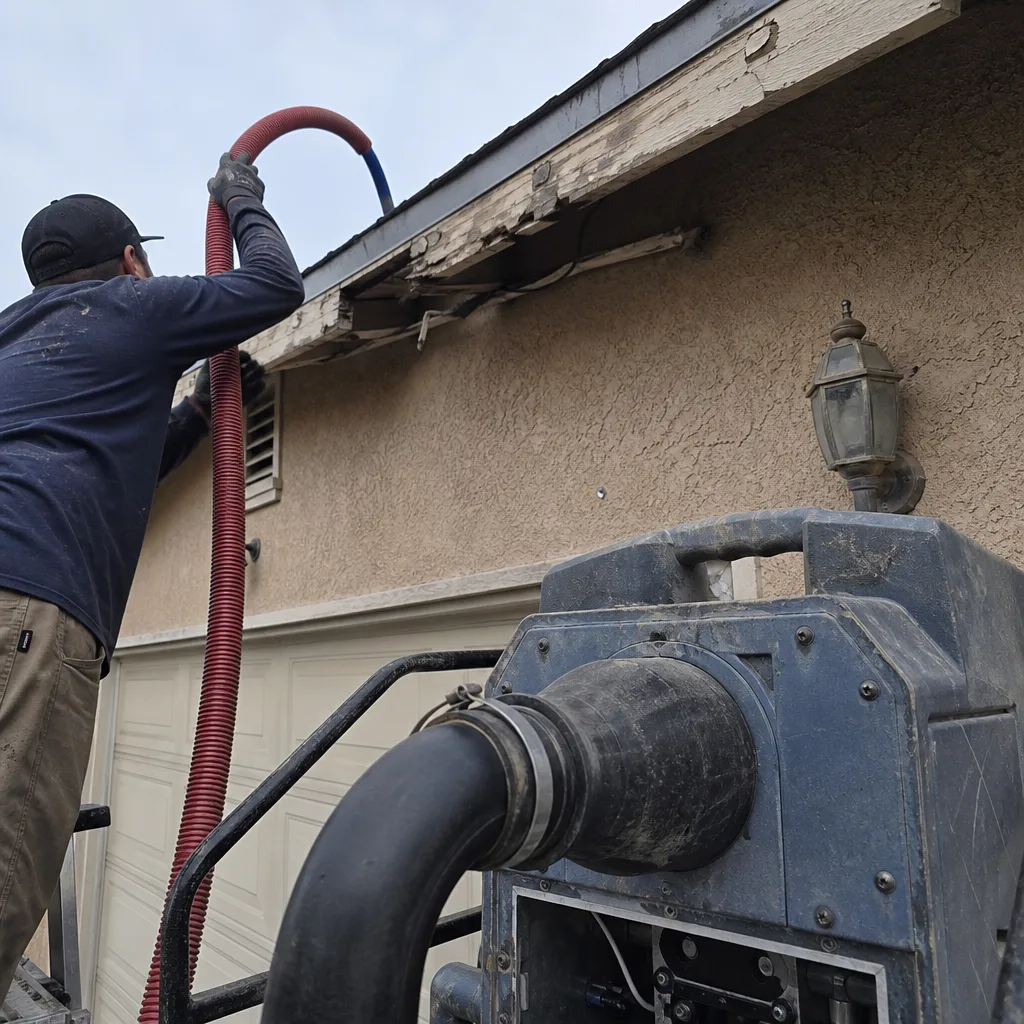 Before
 After
 Before
 After
 Before
 After
When to Call a Professional
Call when the filter is loading faster than usual, when airflow has dropped in specific rooms, when you see dust around return grilles within days of cleaning, or when you can’t remember the last time anyone looked inside your ducts. Also call after any significant Santa Ana event if you notice new dust or a change in system smell. And call if your flex ducts have visible sagging, collapsed sections, or gaps at connection points. These are structural problems, not cleaning problems. Duct Cleaning Perris offers free estimates in Perris. Call (844) 728-0966 and we’ll assess what’s actually going on inside the system. For pricing context, see our Air Duct Cleaning Cost Breakdown: The Perris Homeowner’s Reference for 2026.
Frequently Asked Questions
Most Perris homes benefit from professional duct cleaning every 2 to 3 years, but the interval compresses if the system runs continuously through long hot summers or if Santa Ana events have introduced significant dust. A visual inspection is the most reliable way to know; if debris is visible at registers or the return grille, the system is overdue regardless of calendar time. Call (844) 728-0966 to schedule an assessment.
April or May, before the cooling season begins, is the best window. Cleaning before peak runtime means the system operates clean through the months it’s moving the most air. A post-Santa Ana inspection in October or November is the second priority for homes that experienced significant wind-driven dust. Call (844) 728-0966 to book either window.
Sustained heat causes your HVAC system to run longer, which moves more total air through the ducts and accumulates more particulate on interior surfaces. Attic temperatures in Perris also bake dust onto duct walls, making it harder to remove. Santa Ana winds add coarse desert dust and, in some years, wildfire ash on top of normal household debris.
You can vacuum registers and change filters, but interior duct cleaning requires specialized equipment. A shop-vac cannot reach the interior surfaces of the system, and without brush agitation, material adhered to duct walls stays in place. The tools that work are professional rotary brush systems paired with HEPA extraction, which is what we run at Duct Cleaning Perris.
Brush agitation uses a mechanical rotary brush to dislodge debris from duct walls, then HEPA extraction captures it. Suction-only cleaning pulls air through the system and removes loose material but leaves behind anything that has adhered to surfaces. The difference matters in Perris, where heat bakes dust onto duct interiors. Professional-grade equipment, not shop-vac shortcuts.
Yes, when wind-driven dust enters through attic vents, window seals, and return-side leaks in the duct system, the HVAC blower pulls it through the return plenum and distributes it through the supply ducts. In wildfire years, ash can coat every interior surface. An inspection after a significant Santa Ana season is a reasonable precaution for Perris homeowners.
The Bottom Line
Perris duct care is seasonal because Perris is seasonal, just not in the way a national guide assumes. The calendar that matters here is built around the cooling season, the Santa Ana events, and the attic heat that degrades duct material year after year. Pre-summer cleaning, seasonal filter upgrades, post-wind inspection, and a willingness to repair what cleaning reveals are the difference between a system that lasts and a system that slowly falls apart. The homeowners who understand this schedule are the ones who don’t discover their duct problems on the hottest day of the year. At Duct Cleaning Perris, we clean with brush-agitation equipment, inspect what we find, and repair what needs repairing. One visit, one contractor, from the duct walls to the filter to the vent cap. Call (844) 728-0966 for a free estimate.
Written by the team at Duct Cleaning Perris, serving Perris since 2014.